
Putting children first during separation: supporting children through family change
Updated: Sep 3
Discover how parents can support children through separation, reduce the impact of family change and make child-focused decisions that put their wellbeing first.
Separation can be one of the most emotionally challenging experiences a family goes through.
Alongside dealing with the breakdown of a relationship, parents are often trying to support children who may be confused, upset, or struggling to understand what is happening around them.
While every family’s situation is different, one thing remains consistent: children are usually affected less by the separation itself and more by the level of ongoing conflict between parents.
This is why finding constructive ways to communicate and make decisions after separation is so important.
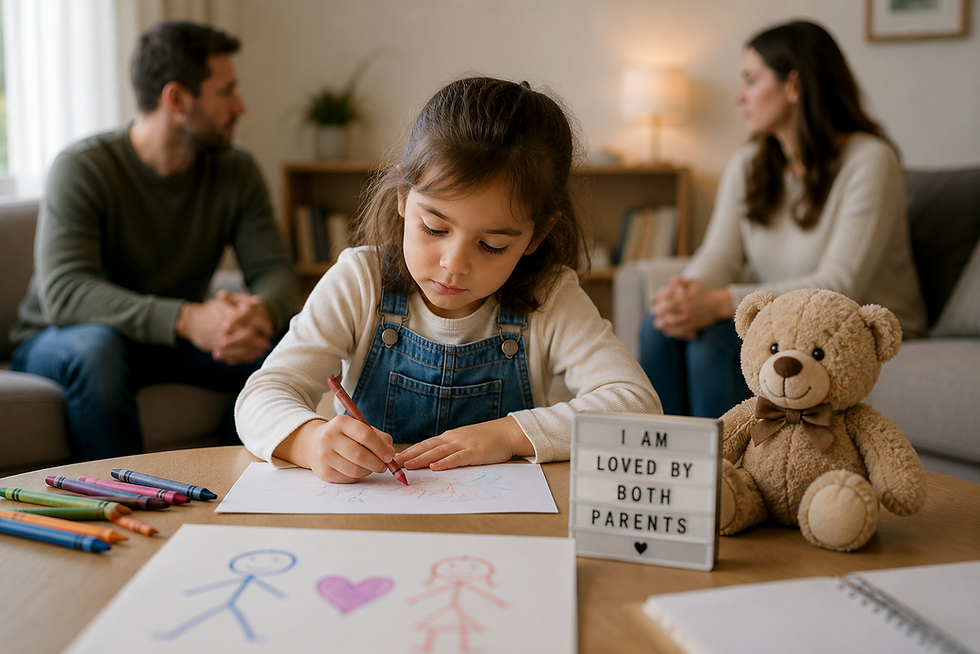
Understanding separation from a child’s perspective
Children do not experience separation in the same way adults do.
They may not fully understand:
Why the separation is happening
What will change
Where they will live
Whether both parents will still be there for them
Children can sometimes worry:
The separation is their fault
One parent may leave permanently
They must choose sides
They should protect one parent’s feelings
Because of this, reassurance, consistency, and stability become incredibly important.
Children need protecting from adult conflict
Research and family professionals consistently recognise that ongoing parental conflict can have a significant emotional impact on children.
This may include:
Arguments during handovers
Negative comments about the other parent, or their new partner
Children becoming involved in adult issues
Communication through children
Tension around arrangements
Even where parents strongly disagree, trying to shield children from conflict can make a huge difference to their emotional wellbeing.
Communication matters
One of the biggest challenges after separation is communication between parents.
Emotions are often still raw, and practical discussions about children can quickly become stressful or confrontational.
Constructive communication does not mean parents need to agree on everything. Instead, it often means:
Keeping discussions child-focused
Remaining respectful where possible
Avoiding blame or criticism
Creating clear arrangements and boundaries
Reducing unnecessary conflict
For some families, co-parenting works well. For others, more structured parallel parenting arrangements may be more appropriate.
Creating workable child arrangements often requires parents to move beyond past disagreements and focus on what their children need going forward. Developing healthier communication habits can make this process easier, which is why I have written about Nonviolent Communication and Family Mediation and how these principles can support separating families.
Listening to children appropriately
Children should feel heard, supported, and reassured during separation.
However, there is an important difference between listening to children and placing adult responsibility onto them.
Children should never feel pressured to:
Choose between parents
Carry messages
Take sides in disagreements
Make decisions they are emotionally unprepared for
Instead, parents can help children by:
Encouraging open conversation
Validating emotions
Providing reassurance
Maintaining routines where possible
The importance of stability and routine
During periods of uncertainty, children often benefit from consistency.
Simple things can help create reassurance, including:
Predictable routines
Clear arrangements
Consistent boundaries
Calm handovers
Regular communication with both parents
Children do not usually need perfect parenting after separation. They often need stability, reassurance, and the freedom to continue loving both parents safely.
How mediation can help
Mediation can help separated parents have more constructive conversations around:
Parenting arrangements
Communication
Boundaries
Handover arrangements
Decision making involving children
Rather than focusing on blame, mediation encourages parents to focus on practical solutions and the needs of their children moving forward.
Many parents find mediation helps reduce tension and provides a calmer environment for discussing issues that may otherwise become difficult or emotionally charged.
There is no “perfect” separation
Many parents worry about getting everything exactly right after separation.
The reality is that separation is difficult, and most parents are simply trying to navigate a major life change as best they can.
What often matters most is not perfection, but the willingness to:
Prioritise children’s wellbeing
Reduce conflict where possible
Create stability
Support healthy relationships with both parents
Conclusion
Separation can be challenging for both parents and children, but the way parents manage communication and conflict moving forward can make a significant difference.
By focusing on children’s emotional wellbeing, creating stability, and finding constructive ways to manage parenting after separation, families are often better able to adjust to the changes ahead.
Where communication becomes difficult, mediation can provide a supportive and structured space to help parents move forward in a more child-focused way.


Comments