

What is mediation?
Family mediation (a.k.a. Divorce mediation) provides a supportive space for families to talk, listen, and find solutions during challenging times. Rather than focusing on conflict, mediation encourages cooperation and understanding, helping families move forward in a way that feels fair, respectful, and future-focused.
It's a structured process designed to help separating couples and families resolve disagreements around children, finances (including pensions), and future arrangements. It offers a more cost-effective, time-efficient alternative to legal proceedings, while keeping decision-making firmly in the hands of those involved.
Is mediation right for me?
Family mediation may be right for you if you want to resolve issues fairly and constructively, without the stress, delay, and expense of going to court. It works best when both parties are willing to engage in open discussion and focus on practical solutions.
Mediation can help if you’re looking to make arrangements for children, agree on finances, or plan next steps following separation or change. It offers a confidential, neutral space where your voice is heard and decisions remain in your control.
Must I try mediation before applying to the courts?
In most family cases, you are required to consider mediation before applying to the court. This usually involves attending a Mediation Information and Assessment Meeting (MIAM).
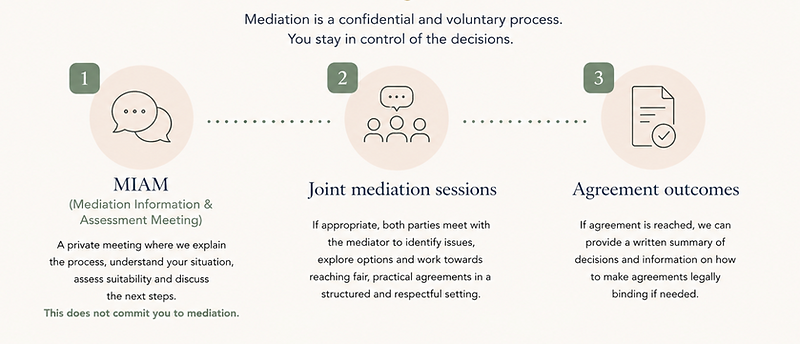
A MIAM is not mediation itself. It is a confidential, one-to-one meeting with a qualified family mediator who will explain how mediation works, assess whether it is suitable for your situation, and give you the opportunity to ask questions. Attendance at a MIAM does not commit you to continuing with mediation.
If mediation is appropriate and both parties are willing, sessions can then be arranged. If mediation is not suitable, or if one or both parties choose not to proceed, the mediator can sign the relevant court form to confirm that mediation has been considered.
There are some circumstances where a MIAM is not required, such as cases involving domestic abuse or urgency. Where court is necessary, guidance will be provided on next steps.
Helpful guides before starting mediation.
Many people have questions before taking the first step. These resources explain how mediation works and how it can help:
-
Why choose mediation for child arrangements instead of court
-
How family mediation saves time and money
-
What happens during a MIAM?
Reasons to mediate.
-
Needing to sort out issues you're unable to deal with by yourselves
-
Wanting to work out arrangements together, instead of going to separate solicitors and the courts
-
Wanting an amicable divorce and to stay on good terms with each other
-
Needing someone impartial to help you manage discussions on specific issues
-
Wanting to avoid legal costs as far as is possible
-
Wanting an out-of-court settlement
-
Wanting someone who would be unbiased, objective and knowledgable
-
Wanting practical and emotional help at the same time
-
Wanting to be told 'Whats fair'