
Can you be separated and still live in the same house?
When a relationship ends, there is often an assumption that one person will move out.
But what happens when that simply isn't possible?
Perhaps neither of you can afford to rent somewhere else. Perhaps the family home needs to be sold first. Perhaps you have children and want to avoid disrupting them while you work out what happens next.
Or perhaps, despite deciding that your relationship has ended, you are simply not ready or able to live separately yet.
So, can you actually be separated while still living under the same roof?

Yes – separation doesn't necessarily mean living in different homes. You can be separated and still live in the same house
Being separated is not simply about having two different addresses.
A couple can be living in the same house while having separated, although what that looks like in practice will depend on their individual circumstances.
Separation is generally about whether the relationship has actually come to an end, rather than simply whether one person has moved out.
That can make things complicated, particularly when you are still sharing the same kitchen, bathroom, finances and family routines.
For some couples, living under the same roof for a period of time can be a practical short-term arrangement.
For others, it can make an already difficult situation much harder.
What does separation under one roof actually look like?
There isn't one model that works for everyone.
Some separated couples may have separate bedrooms and largely live independent lives within the same property. Others may continue sharing some household responsibilities, particularly where they have children.
You may need to think about things such as:
Where each of you will sleep
How you will manage meals and household chores
Whether you will continue sharing finances
How bills and mortgage payments will be dealt with
What you will tell family and friends
How you will manage time with the children
Whether you will attend family events together
What boundaries you each need while you remain living together
None of this is necessarily straightforward.
And when emotions are still raw, even apparently small decisions can become a source of conflict.
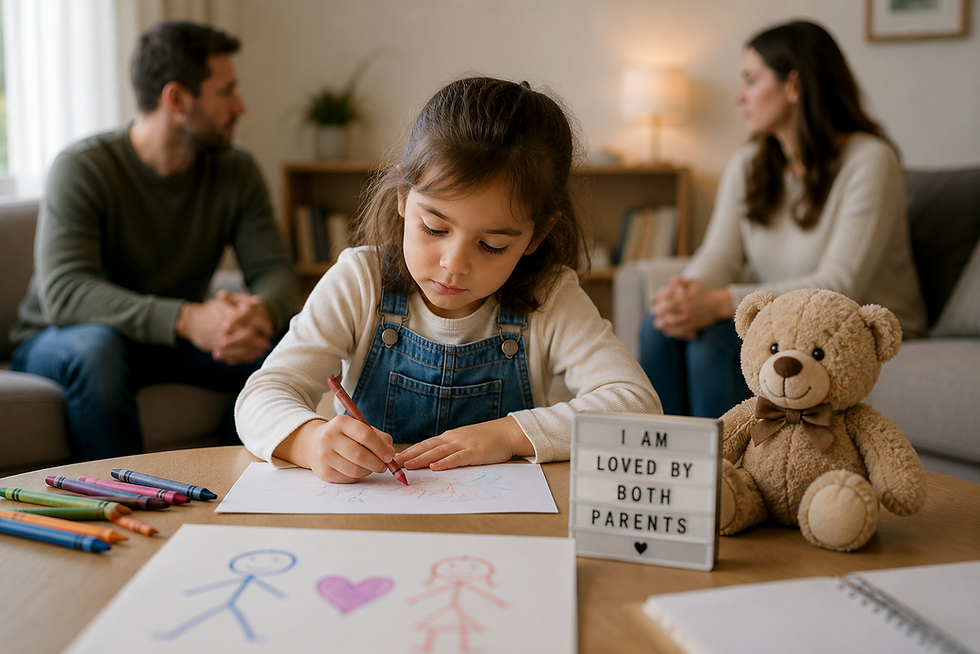
What about the children?
This is often one of the biggest reasons parents continue living together after separating.
You may feel that keeping the family home unchanged is better for the children, at least for the time being.
That can sometimes provide continuity while you work out what happens next.
But children can also find it confusing if their parents are living together but no longer in a relationship.
The important thing is often less about creating a perfect arrangement and more about giving children appropriate, age-related information and reassurance.
They should not be placed in the middle of disagreements or expected to carry messages between their parents.
You may also need to agree how you will manage everyday parenting while you are still living together – including school runs, activities, weekends, holidays and time with each parent.
What about money?
Living under one roof can make financial arrangements particularly complicated.
You may still have a joint mortgage, shared bills and joint accounts, while at the same time trying to establish some financial independence from each other.
It can be helpful to distinguish between:
What needs to happen now – such as paying the mortgage, utilities and other household expenses.
What needs to happen later – such as deciding whether the family home should be sold, transferred or retained.
You don't necessarily need to resolve every financial issue immediately.
But having some clarity about how the household will operate in the meantime can reduce uncertainty and prevent disagreements from escalating.
Where there are significant financial assets, pensions, businesses or other complicated financial arrangements, legal advice may also be appropriate.
Does living together mean you aren't really separated?
Not necessarily.
The fact that you continue to live at the same address does not automatically mean that you are still a couple.
However, if you need to establish the date on which you separated – particularly for legal or financial purposes – the circumstances can become important.
There are different legal considerations depending on what you are trying to establish, so if the date or nature of your separation matters, it is sensible to obtain appropriate legal advice.
This is one of those areas where an assumption that "we live together, so we can't be separated" can be misleading.
How long can you live together after separating?
There isn't a simple fixed period.
For some people, it might be a few weeks while one person finds somewhere to live.
For others, financial circumstances may mean that it continues for much longer.
The question is less about how long you have lived together and more about whether the arrangement remains workable.
If every conversation becomes an argument, there is constant tension in the home, or the children are being affected, continuing to live together may no longer be the best option.
Equally, if you can establish clear boundaries and communicate reasonably, living together temporarily may provide valuable breathing space while longer-term decisions are made.
You don't have to work everything out at once
One of the difficulties with separation is the feeling that everything needs to be decided immediately.
Where will we live?
What happens to the house?
What about the children?
Who pays for what?
What happens to our savings?
What will we tell everyone?
These are important questions, but they don't necessarily all need an answer on the same day.
Sometimes the first step is simply agreeing how you are going to manage the next few weeks.
That might mean putting some temporary arrangements in place while you both have time to consider the longer-term decisions.
Where can mediation help?
Mediation isn't about telling you whether you should stay together or separate.
It is about helping you have conversations about the decisions that need to be made.
If you have separated but are still living together, those conversations might include:
How you will manage the home
Parenting arrangements
Communication
Household finances
What happens next with the family home
How and when you might move into separate homes
What information you each need before making longer-term decisions
You don't have to have everything agreed before coming to mediation.
And you don't necessarily have to know what the final arrangement will look like.
Sometimes the most useful place to start is simply working out what needs to happen now, rather than trying to solve the whole future at once.
Separation doesn't always start with someone moving out
For some families, separation begins with one person leaving the family home.
For others, it begins with a conversation and a decision that the relationship has ended – while practical circumstances mean that both people remain living in the same house for a while.
There is no single way for separation to look.
What matters is finding a way forward that is workable, particularly where children, housing and finances are involved.
If you are separated but still living together and finding it difficult to work out what happens next, mediation may give you a structured space to start having those conversations.
Sometimes the first step is simply having the conversation
If you're separated but still living together and struggling to work out what happens next, you don't have to figure it all out on your own. Mediation can give you both the opportunity to talk through the practical issues, understand what matters to each of you and start working towards arrangements that work for your family.
Further information
If you're considering separation, there are some useful sources of independent information available. The GOV.UK guidance on separating or divorcing covers some of the practical issues you may need to consider, including children, money and property.
If you're continuing to live in the family home, GOV.UK also provides guidance on staying in your partner's property during separation or divorce. For practical information about arrangements for children, you can read the GOV.UK guidance on making child arrangements, while Citizens Advice has guidance on what happens to your home when you separate.


Comments